Donald Super: Life-Span, Life-Space Theory
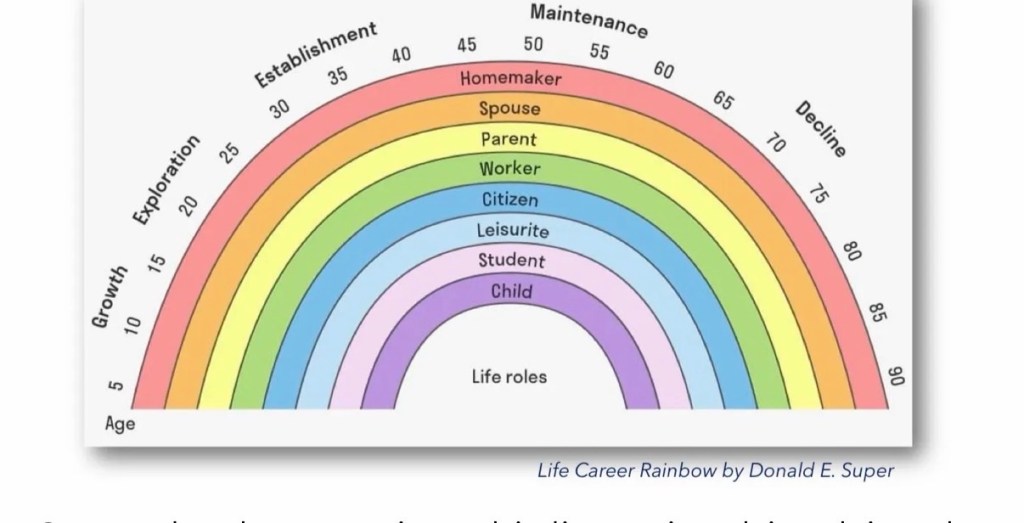
Description
The image depicts a diagram titled Life Career Rainbow by Donald E. Super. It shows various life roles across different age ranges, structured in an arch/rainbow format.
•Age Range: Moves up along the arch from bottom left to bottom right, starting from 5 and increasing in increments of 5 up to 90.
•Life Stages: Also positioned along the arch, and the stages are Growth, Exploration, Establishment, Maintenance, and Decline.
•Life Roles: The rainbow is divided into bands, each representing a life role. From the smallest band, and the bottom up, these roles are:
-Child: Purple, spanning ages 0 to 15.
-Student: Light purple, spanning ages 5 to 25.
-Leisurite: Light Blue, spanning ages 5 to 90.
-Citizen: Blue, spanning ages 15 to 90.
-Worker: Green, spanning ages 25 to 65.
-Parent: Yellow, spanning ages 25 to 60.
-Spouse: Orange, spanning ages 20 to 70.
-Homemaker: Red, spanning ages 25 to 65.
•Each band is positioned to show the overlap and progression of roles throughout a person’s life.
Image from: (Soo Yin, 2025)
What is Donald Super’s Life-Span, Life-Space Theory?
Donald Super’s Life-Span, Life-Space theory is a theoretical framework that shows career development as a lifelong process rather than a singular event or period of time (Soo Yin, 2025). Super’s theory demonstrates how career development connects to different stages and roles of life.
While this theory does emphasize life stages and roles, another central concept of this theory is self-concept, which is how individuals see themselves (Soo Yin, 2025). This could include their interests, personality, values, skills, work capacity, and more. Super’s theory demonstrates how self-concept ties into life stages and roles, and career development over the lifespan.
Benefits
Super’s theory presents many benefits when it comes to career development, such as (Elmouden, 2025):
•Recognition of career development as a lifelong journey rather than a singular event
•Integration of self-concept into career decision making and development
•Emphasis on the impact of life stages and roles on career exploration and development
•Aiding individuals in understanding work-life balances
Limitations
While Super’s theory has many strengths, the main limitation is that this theory fails to acknowledge and demonstrate how other external factors may also impact career development, such as (Elmouden, 2025):
•Financial limitations
•Actions of others, such as supervisors or mentors
•Discrimination of marginalized groups
•Stages are presented as linear, excluding nontraditional career pathways
Life Stages
Super indicated 5 specific life stages in which career development happens, which are ((Soo Yin, 2025):
•Growth: Taking place between birth and 14 years of age, this is when we begin to understand ourselves, our interests, and develop self-concepts.
•Exploration: Happening between the ages of 15 and 24, this is the stage where we explore and experiment with career paths, education, and other available options.
•Establishment: Taking place between ages 25 and 44, this stage represents entering the workforce, stabilization, and advancement in our careers.
•Maintenance: Happening between the ages of 45 and 64, this stage is where we preserve our achievements and continue to update our skills.
•Disengagement: This stage takes place after age 65, and includes leaving the workforce, retiring, and career reflections.
It’s important to remember that these stages do not have to be concrete, and individuals may not always move through these stages linearly, or within these age categories. For example, someone’s career exploration stage may start later in life.
This is why we at VI Career Development aim to provide resources that cover the many stages of career development to ensure that no matter what stage you’re at, we can provide helpful and accessible resources to get you the tools and information you need for your specific experiences.
How VI Career Development Integrates Super’s Theory:
VI Career Development integrates the concepts of Super’s Life-Span, Life-Space Theory throughout our available resources and tools.
•Our available personality-based career assessment ties into Super’s concept of self-concept, helping individuals to learn more about themselves and how their personalities can tie into their career exploration and choices.
•Resources and tools are provided that cover many stages of career development such as exploration, establishment, and maintenance.
We also recognize the limitations of Super’s theory, and we make sure to cover external factors that may impact career development.
 VI Career Development